Saturday, March 30, 2013

…And Still I Haven’t a Clue - June 2012

IMG_2608


Ten years ago, my life as I knew it ended.  I lost almost everyone I cared about.  I lost the place that had been my second home for five years.  I lost work, play, and society.  I no longer had the right to free education; getting a job became an expectation rather than a suggestion; and learning became a means rather than an end.


Ten years ago, I graduated high school.


In the years since, I’ve gotten a university degree.  I’ve worked at a dozen different jobs, travelled abroad, and learned how to live on my own.  I’ve made acquaintances from all over the world and even a couple of friends.  In the last year or so I’ve even begun to think of myself as an adult.  I can look back at my teenaged self and see how limited my understanding was, and how many mistakes I made.  Yet, in many ways, I’m not that far removed from the the depressed, lonely, Hamlet-reading, Marvin-quoting kid I used to be.  I’m still not sure what to do with my life.  All I’ve ever wanted was a nice home, a loving family, and some form of employment that was both gainful and meaningful; yet somehow I find myself perennially hopping from country to country, like an inverse George Bailey.  I never learned to do things that most people take for granted, like drink, date, or dress stylishly; nor did I pick up the knack all adults seem to have of forming relationships easily and dropping them just as blithely.  And if I had to go back to grade thirteen and do it all over again, I’m not sure I wouldn’t make all the same mistakes.  It’s ten years later…


Okay, maybe I have a few clues, but it’s still not easy.


IMG_2594


I got to see more of this spring’s sports competitions than any of the previous events.  On Saturday I was lucky enough that the volleyball was being held at my school.  I watched my team beat another in a nail-biting match, and cheered my lungs out as they faced their next competitor.  Sadly, it was not to be, and despite putting on a really good game, they were squarely defeated.  On Sunday I attended the baseball semi-finals.  This was a lot less exciting, but my team did manage to win the game, meaning that they got to play the finals the next day.  I turned up on Monday prepared to show as much enthusiasm for my baseball boys as I had for my volleyball girls, but the game ended up being incredibly dull.  Neither team scored a single run until the end of the last inning, and when they finally did I was so relieved that I barely cared that it was the other team!  At least they cancelled class for the rest of the day, so I had an excuse to go home early.


To make up for our weekend of sport we got a holiday on Thursday and Friday, which allowed me one more short trip: a weekend in Yokohama with my tea lady!  We took the bus down to Tokyo on Friday, and spent the afternoon seeing the sights.  We went to the Skytree first, Tokyo’s new tallest building.  It had been under construction for a while, and visible on all of my previous visits to the city.  It was finally open, but tickets to go up it were already sold out for weeks to come, so we only got to see it from the bottom.  We also paid a visit to the Tokyo Tower (now dwarfed by the Skytree, at only half its height), Shinjuku, and Kappabashi-dori.  The latter is famed for its plastic food stores.  No, I don’t mean food that tastes like plastic, like those cheap waxy Easter eggs, tasteless hot dog wieners, or gosh-awful processed cheese slices.  I mean food made of plastic, usually displayed in restaurant windows.  I’ve been a fan of plastic food ever since I first encountered it in Hong Kong and spent months believing it was the real thing!  I would have loved to buy some as a souvenir of my time in Asia, but even something as simple as an ice-cream would have cost me around $40, so in the end I settled for a miniature okonomiyaki fridge magnet.


When you think about it, Yokohama is probably the first Japanese city I ever heard of, and the Great Buddha of Kamakura one of the first Japanese icons.  So I was quite chuffed to be making the city the location of my last Japanese holiday, and the statue the destination of my first excursion in that city.  My tea lady and I went out to see it on Saturday, and in spite of the rain we visited many of the surrounding temples, window shopped the souvenir stores, and got some decent pictures of the Buddha itself.  In the evening we went out to Yokohama’s Chinatown, famous for being the largest in Japan.  It was nice to be surrounded by Chinese things again, and the place really did remind me of Hong Kong, but I was still woefully disappointed by the barbecued pork bun I tried.  Why do the Japanese have to fail at making Chinese-style barbecued pork buns??!!


Other than that this month’s been mostly about routines and leaving preparations.  I’ve finally booked my flight, which means I now know when I’ll be leaving Japan and when arriving in Australia.  I’ve started to sort through my stuff, deciding which things to take, which to leave, which to send home, and which to put in the bin.  Meanwhile, I still have singing practice one night a week, and Dungeons & Dragons another night.  I’m paying weekly visits to all the first- and third-year classes and to my elementary schools, and eating lunch with my students five days a week.  It’s busy and stressful, and as I enter my final month, it’s only going to get more so.


IMG_2555


In the news this month, an especially gruesome story has been added to Canada’s surprisingly long list of grisly murders.  It started back in May, when the Conservative Party of Canada received a package containing a human foot.  Yes, that’s right, a foot!  This was followed by three more packages (addressed to the Liberal Party and two schools in Vancouver), a human torso in a suitcase, an apartment full of blood, an internet snuff video, and an international manhunt that ended with the arrest of the killer in Germany.  This is a level of disturbing that I don’t really think the words “WTF???” are adequate to deal with, so I’ll just say that I’m glad I’m not the person who opened any of those packages.  Or, obviously, the victim.


In other news, science fiction writer Ray Bradbury has died.  I know him as the author of Fahrenheit 451 and numerous short stories, and though far from an expert on him, I enjoyed and respected his work.  In Japan, the last fugitive members of Aum Shrinrikyo have finally been captured.  Aum (which is actually the Sanskrit word “om”, pronounced “ōmu” in Japanese) was the organisation that released Sarin gas in the Tokyo subway system in 1995; the arrests mean the end of a seventeen-year manhunt.  And in Australia, an inquest has definitively ruled that the 1980 death of Lindy Chamberlain’s baby was the result of a dingo attack, and not because of her or any other human’s interference.  I know nothing about this case other than what was in the movie A Cry in the Dark, but I gather it’s a big deal in Australia and that people there are glad to have this issue resolved.


IMG_2583


Movies I’ve seen this month:


Rajio no Jikan – Clever Japanese comedy about the production of a radio drama and the impromptu revisions that get made in the process of airing it.  Full of bright humour and sharp satire, this is one movie that any fan of films about the media has to watch!  (Three and a half stars)


Books I’ve read this month:


A Wizard of Earthsea by Ursula K. Le Guin – My first time re-reading this book since I was a child.  I had mixed feelings about it back then, and I’m still not sure what I think of it.  I respect the ways in which it deviates from standard fantasy motifs, but, while I enjoy some of the more horrifying elements, it seemed unnecessarily dark.  Oddly, I thought I understood the story, but now I’m not so sure, and I came away from my second reading even more confused than I went into it.  Might be a good idea to re-read the rest of the trilogy and check out the other Earthsea books too.


Stardust by Neil Gaiman – My first Neil Gaiman book, a kind of modern fairy tale about the intersection of Faerie and Victorian-era England.  Not an outstanding work of fantasy, but entertaining and good enough to make me consider reading more of Gaiman.


The Last Unicorn by Peter S. Beagle – That’s right, I read it again!  It’s that good!  And it’s going on my list of favourite books of all time!

Wednesday, March 6, 2013

Embracing My Inner Geek - May 2012

IMG_2702


I have three precious months left in Japan, and I’m making the most of them.  At school, I’m determined to enjoy my students while I still have them – particularly the first years!  To that end, I’ve enacted a plan I considered and dismissed many times in the past.  Instead of eating lunch in the principal’s office with my co-workers, I’ve started eating with my first-year students, going to a different class every day of the week.  Even though I’ll be leaving soon, the timing feels right: I ate lunch with these students last year when they were in elementary school; I’m just continuing the practice.  And with my tea lady gone, the principal’s office isn’t as inviting a place as it once was.


As I mentioned, the new textbook places slightly more emphasis on phonics than the previous ones.  To pick up on that, I’ve resolved to make it a daily feature of my lessons.  Sadly, Japanese schools do not pay much attention to phonics; the best most students learn is a kind of Romanised syllabary, which is useful for sounding out a word like “koala”, but doesn’t help much with “change”, and implies that “stretch” be rendered “sutoretochi”.  But these new kids are bright, and I’m convinced that their reading and pronunciation will both improve if I teach them proper phonics as anglophone children learn them.


I’m starting with the very basics: the alphabet.  I’ve made a set of cards featuring each letter and an “anchor word” drawn from the textbook.  Anchor words begin with the letter in question and typically model its most common pronunciation.  I’ve started drilling these words, kindergarten style: “A says ‘a’, ‘a’, ‘apple’.”  “B says ‘bh’, ‘bh’, ‘boat’.”  Etc.  I might not seem like much, but I’m planning a whole regimen to build on it: next I plan to teach start sounds, then end sounds, then vowels.  If the kids are as smart as I think they are, by the time I leave I’ll have them reading and spelling three letter words based on how they sound!  The big challenge will be to keep it fun, but so far the students seem to be enjoying the drills, and I plan to practise using Bingo and other games.


Unfortunately I won’t have time to tackle the interesting stuff: “Magic E”, diagraphs, blends.  All I can hope is that the teacher and/or my successor is inspired to pick up where I left off, or that, at the very least, I plant a seed in my students’ heads that inspires them to pursue a better understanding of English phonology.


In my third-year classes, I’ve been trying to make better use of an ALT-produced magazine.  The magazine, created and written by members of the ALT community, uses language specifically tailored to students, and aims to encourage English reading.  Since the textbook is rather short on reading material, and since students rarely read anything unless explicitly told to do so, I’ve been designing activities around the articles in the magazine.  Doing each activity forces the students to think about the content of the article, hopefully guiding them to an understanding of it, rather than simply an ability to listen and repeat it.  And it also gives me an excuse to hand out the magazine in class, where there’s at least an outside chance the students might glance at it.


The weather has finally gotten nice, and the leaves have started to return to the trees around my apartment.  May also means the first of our split monthly meetings.  From now on, there will be one ALT meeting for those of us staying in Sendai, and another for the ones going home.  They’ll be helping us through the myriad things we need to do in preparation for leaving the country.


Oddly enough, the tail end of my time in Japan is seeing me pick up some new hobbies.  Since March the singing group has reformed and has been practising a new set of songs.  Our aim is to perform them at a special ceremony where we present the money we raised to a support programme for orphans.  So far no one’s sure when this ceremony will be; for my part, I don’t care.  I’m happy just to have an excuse to sing!


The leader of our singing group is a teacher who works at the international school.  Recently, he’s managed to get me involved in another activity.  One night I heard him talking to another ALT about a game he was playing, something involving “halflings” and “paladins” and “encounters” and “alignments”.  It all sounded suspiciously familiar, so I asked him about it, and he explained that he was trying to recruit some gaijin for his Dungeons & Dragons group.  Like everyone else, I’ve heard of Dungeons & Dragons, and I even knew people who played it in high school, but I’d never played it myself.  “Want to join?” he asked.


So for the past couple of weeks I’ve been discovering the weird, fantastic, and highly derivative world of D&D.  It’s a steep learning curve for me.  I’ve never played anything like it, and it’s taking me a while to figure out all the different skills and moves and which dice to roll in which situation.  All the same, it’s been kind of fun.  I decided as a newbie I should play a character who was good at fighting and wouldn’t have to do a lot of thinking or decision making.  So I’ve made myself a female dwarf fighter with a battle axe, a throwing hammer, and a chip on her shoulder.  She’s an expert in smashing things, and she’s also built like a tank, so she’s happiest in the thick of the action.  The other players seem to like her, and as long as there are bad guys to kill, I quite enjoy playing her.


Only one other gaijin has joined the group so far, one of the South African ALTs.  He in turn has been introducing me to another geeky subculture: bronies.  A “brony” is an adult fan of the T.V. show My Little Pony: Friendship is Magic.  I of course remember My Little Pony from my childhood; at one time I owned several Little Ponies myself.  But until he told me about it I’d been all but unaware of the new T.V. show based on the franchise, and completely unaware of the adult fan following it has attracted.  He’s given me several of the episodes, and I’ve been watching through them, but so far I’m afraid his attempt at indoctrination has failed.  The show is cute and harmless enough, and I’d certainly let my children watch it if I had any.  But why it should generate so much enthusiasm among thirty-year-old males remains a mystery to me.


My tea lady invited me to a concert put on by one of Sendai’s more artistically-focused high schools.  It was really impressive; my students can play well enough, but I’ve never seen them march, dance, and play brass instruments all at the same time!  I also attended the international school’s annual musical at the invitation of our singing instructor.  Being put on by children aged between six and seventeen years, it wasn’t great, but as free entertainment goes it was quite satisfactory.


In the news, this month the world was treated to that most portentous of celestial phenomena: a solar eclipse.  I was particularly excited about it, as the event was clearly visible in Japan on Monday morning, at just about the time I was heading for work.  The eclipse was total in Tokyo, and while Sendai is a few degrees of latitude north of there, we were still close enough to witness the partial version.


Contrary to my expectations, a partial eclipse does not present itself as a disc of blackness visibly passing across the face of the sun.  For that, I would have needed the special glasses, and I was unable to find any.  Instead, what I noticed on my walk to work was a curious dimness, as though the sun, though clearly visible in the sky, was shining at only half power.  The effect lasted a surprisingly long time: an hour or more from start to finish.  Towards its end, just before the start of class, one of the science teachers lent me her eclipse glasses, and I was finally able to look directly at the sun and see the huge bite taken out of it.  Next time I’ll have to buy my own pair, so I can watch the whole thing properly.


Movies I’ve seen this month:


Men in Black 3 – A completely unnecessary sequel to Men in Black.  Josh Brolin does a decent turn playing a young Tommy Lee Jones, and Will Smith irritates me far less than he used to.  I was also rather fond of the trans-dimensional alien character.  But the plot is unoriginal and full of holes and loose ends; the villain is more annoying than threatening; and the special effects are remarkably poor.  (Two stars)


Men in Black II – I decided I should probably round out my knowledge of this trilogy, and found part two much like part three: mildly entertaining at times, but on the whole forgettable.  (Two stars)


Books I’ve read this month:


The Neverending Story by Michael Ende – While I’m on my children’s classics kick, I decided I was past due to re-read my favourite novel of all time.  One of the most surprising things about doing so was how short it seems, and how quickly I can get through it now that I’m all grown up.  It’s still a brilliantly rich and imaginative story.  And the last few chapters hit me just as hard as when I was a teenager; it was all I could do to keep from crying several times.


The Last Unicorn by Peter S. Beagle – A remarkably sombre and sorrowful fantasy tale utterly unsuitable for adaptation as a children’s film.  I’ve been familiar with the plot since early childhood, thanks to the cartoon version, but I was still blown away by the story and the writing.  To my surprise I enjoyed the second half of the book far more than the first, and was impressed with how real the characters felt in a world that is in other respects gleefully fantastic.  I think I may have to read it again!


Summer Knight by Jim Butcher – I think the Dresden Files may be past its prime.  Harry’s latest adventure has a plot that is almost incomprehensible and villains who are stupefyingly powerful in theory yet prove absurdly incompetent in practice.  There are too many characters that aren’t sufficiently developed, too many twists that aren’t adequately explained, too many intrigues that don’t make sense.  I’m also starting to notice cracks and inconsistencies in the mythology.  Butcher needs to reign in his style a bit, and focus more on writing well than writing a lot.


The Girl who Kicked the Hornets’ Nest by Stieg Larsson – The unintended conclusion to the inadvertently foreshortened Millennium series, this book nonetheless wraps up all the major story elements in a more or less satisfying way.  Over all, I’d say the Millennium trilogy is a worthwhile read, primarily thanks to its heroine.  I have to say, however, that I think Larsson goes overboard in his use of rape and misogyny as marks of villainy.  I was already an un-fan of the Straw Misogynist trope when Joss Whedon was abusing it, and its rise in popularity isn’t making me dislike it any less.

Thursday, February 21, 2013

Nice to Meet You, Too - April 2012

IMG_2491


After all the shuffling around that had occurred last year, it was a bit of a shock to walk into the staffroom on my first day back and find my desk in the exact same place as I left it.  There are very few new faces on the staff, and the only change in the seating plan is that the first-year teachers (who are now second-year teachers) have collectively swapped spots with the third-year teachers (now first-year teachers).  There’s a new principal, but as I didn’t spend much time talking to the last one, the change doesn’t affect me much.  All the English teachers are the same.


There is, however, one change that I’m taking hard: the loss of my tea lady.  I miss being greeted with a warm “Ohayo, Aisu-Tii!” every morning, her bright smile, the opportunity to wander into the accounting office and strike up a conversation with her whenever I feel bored.  I feel exactly like Bertie Wooster without Jeeves: a helpless baby who can barely tie his own necktie without assistance!  The new tea lady seems quite nice, and I plan to be as friendly with her as the language barrier allows.  But she lacks her predecessor’s linguistic adventurousness, and though we may get along, there’s no way we’ll ever have the same kind of relationship.


My consolation is the prospect of a new school year, with new students and a new curriculum.  You may recall from an earlier post how chuffed I was about some of my elementary school students last year.  Well, many of those elementary school students are now my first-years!  I’m looking forward to teaching them: they’re so smart and enthusiastic, and they already have a solid English foundation from last year.  I’m sure with proper instruction they’ll easily outstrip their sempais* in no time.


One change, or rather non-change, that’s disappointed me is that all the teachers are staying with the same classes.  Not the same grades; the same classes, i.e. the same groups of students.  This means that all the English teachers have moved up a grade with their students or, in the case of the third year teacher, seen off the graduates and taken on the new arrivals.  I find this system ludicrous for a couple of reasons.  One is that it just makes sense to me to rotate teachers among different students, since not all teachers are equally good, and not every teaching style is suited to every student.


The other is that I’m aware of my teachers’ particular strengths and weaknesses, and they seem ill-suited to the grades they are now teaching.  The new third-year teacher has a lot of experience and a good understanding of the grammar she has to teach, but she also has by far the weakest English of the bunch.  Her students have had her for two years already, meaning that they’ve never had an English teacher who can speak more than what’s necessary to teach the curriculum.  The new second-year teacher rarely brought me to class last year, and I don’t expect him to bring me to class this year either, meaning that his students will have precious little ALT time during their junior high school days.


The silver lining is that the strongest English-speaker will be taking on the new class.  To me, putting her with the weakest class seems like a waste, but it does mean yet another advantage to those fabulous newbies.  Since she’s also pretty good about using my ideas, I’m also looking forward to collaborating with her on this new group.


This year sees the introduction of new textbooks.  In junior high school, we have an updated edition of the same textbook that is slightly accelerated and more challenging.  I’m particularly pleased to see that the first-year book includes a few pages on phonics, something that’s been sadly lacking in previous years.  In elementary school, there is a brand new textbook, which I’m told is slightly more advanced, although it looks similar to the previous one.


Another change in one of my elementary schools is that there’s now a designated English room and teacher to whom the students all go for their English lessons.  In theory I really like this idea, as it associates English with a specific space and teacher, and allows the students to be taught by an expert rather than their usual teacher.  In practice, the “expert” speaks almost no English; indeed, one of the third-year teachers speaks much better English than he does!  The new set-up has also led to some confusion about teaching roles in the classroom.  The new guy seems to think that I should be delivering most of the content, and that his job is to act as a facilitator.  I, on the other hand, am used to the local teacher taking the lead, and to assisting only with technical matters like vocabulary and pronunciation.  I have no wish to change the system now, especially so close to my time for leaving, so I’m insisting that he run the class and give me specific instructions when he wants my participation.


I’ve decided I’m not going to try starting up the swing dancing club again this year.  The only person who’s come to classes at all of late is the mother of a student, and it seems farcical to keep the club running just for her.  A part of me is tempted to try it out just to see if some of my wonderful freshmen can be enticed to join.  But I’ve been too discouraged by previous years’ experiences, and anyway, I’m only going to be around for four more months.


The weather stayed fairly cold in April, but as the month drew to a close it became more springy, and the cherry blossoms have started to appear.  I was determined to enjoy them properly this year, so I and the Singaporean ALT went down to Ogawara, which we’d heard was a prime viewing location.  The river there was lined with cherry trees, and we took a leisurely late-afternoon stroll along the waterfront, admiring the blooms overhead and the petals which had carpeted the ground.  I was also able to see more at Nishigaoka park, where I went with some of the church youth and was able to take some better pictures.


For Golden Week I mostly stayed home and did spring cleaning, but I did also make it out to a nice yakiniku restaurant with the Singaporean ALT and my tea lady!  It’s nice to be able to spend time with her even thought I no longer see her every day.


In the news this month, Canada has decided to discontinue the penny.  This came as a slightly unpleasant shock to me, as it will mean the sudden worthlessness of my penny collection, and I’m rather fond of the penny, with its maple leaves and its bright coppery redness.  But in other respects I guess this seems like a sensible decision.  I asked my mom if she could mail some of my pennies to me, thinking that they’d make a nice collectible souvenir for my students.  But it turned out the cost would have been too much or the time too long for it to be practical.  I still plan to put some aside, though.  Perhaps they’ll be worth something later on.


Movies I’ve seen this month:


Cars – A cute premise realised in a formulaic and unoriginal story.  Not Disney’s best work.  (Two and a half stars)


* “sempai”: Japanese for “upperclassman”, a schoolmate in a higher grade.

Wednesday, January 30, 2013

Kyoto - March-April 2012

IMG_1941 


If there was one city, other than Tokyo, I always knew I would have to visit before I left Japan, it was Kyoto.  I’d considered going there for Golden Week last year, but had been forced to re-think my plans after the earthquake.  So for my last spring break and my last big trip in Japan, I decided to devote an entire week to Japan’s historic capital city.


Due to poor planning on my part, I ran into some difficulty on the way there, and ended up having to get a night bus to the city, arriving early Sunday morning, rather than Saturday night as expected.  I’d booked myself eight nights in a “capsule hotel”, something I’d heard of before but never experienced.  I wasn’t sure what to expect, but it turned out to be a very nice place.  The bunks were sarcophagus-sized and stacked width-wise, with a curtain for privacy and locker space underneath.  Other than that it was much like any other hostel I’ve stayed at.  I checked in, took a long nap, and got up in the early afternoon to begin exploring the city.


Sunday was overcast and rainy, which was unfortunately characteristic of the weather while I was there.  I started with a walk down the street, which took me past Kyoto City Hall, where some kind of parade was happening.  Then I went to Kyoto Imperial Park for a look at the Imperial Palace and a walk around the grounds.  Sadly another unfortunate feature of the weather was that it was not yet sufficiently warm for spring to have begun.  I’d hoped to arrive in “hanami” season, with the cherry trees in bloom, but with the exception of a few plum trees, the city still looked wintry and lifeless.


I couldn’t actually get into the Imperial Palace, but after a peaceful but uninteresting walk I found myself at the Kongo Noh Theater.  I was just in time for the last of three plays being performed that day, and since it isn’t every day one gets to see a Noh production, I bought a ticket.  Obviously I couldn’t understand the dialogue, but the programme included a plot summary, which allowed me to follow along with the story.  This was fairly minimalist; the play seemed to be built on monologues and dance sequences more than on plot.  Though I found the singing style strange, it grew on me after a while, and I started to think that it made a very good device for communicating the grief of the characters.  On the other hand, the characters also used the same style when they should have been communicating more positive emotions, so perhaps it’s just a stylistic device that I as a foreigner don’t understand.


IMG_1922


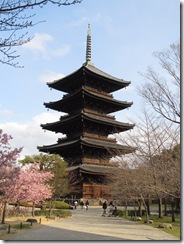
On Monday I went to Nijo Castle, which was rather more interesting than the Imperial Palace.  The grounds could also have benefited from more greenery, but were pleasant to walk around nonetheless.  The building itself was quite interesting.  The “nightingale floor” was deliberately designed to squeak when walked on, in order to prevent sneak attacks.  Walking on it, it really did seem as though there must be birds hidden in the rafters.  The interior artwork was also worth seeing.  Unfortunately, we weren’t able to take pictures inside.  I went to see Toji temple in the afternoon.


Tuesday was one of the nicer days of my visit, and I spent it visiting Kiyomizu-dera.  The building, whose name means “Clear-Water Temple”, is one of Kyoto’s most famous sites.  As interesting as the temple itself, however, is the walk up the Higashiyama (“eastern mountain”) to it, which takes one up several interesting streets lined with artisan shops selling jewellery, pottery, snacks, tea, sake, and all kinds of souvenirs.  I took several hours over the climb, picking up lots of presents for friends and family members, and even a couple of things for myself.


By the time I reached the temple itself, I was pretty tired.  I can’t say I found the place singularly thrilling, and without leaves the view over the tree tops wasn’t that interesting, either.  Still, it was a famous Kyoto site I could say I’d been to, and the trip afforded a great shopping experience, if nothing else.


IMG_2072


I made Wednesday my Philosopher’s Walk day.  The Philosopher’s Walk is a walking route along a canal that became famous for being the favourite of a local professor.  The canal was unimpressive, and, as already noted, the cherry blossoms that would have made the route lovely had yet to appear.  The walk was notable mostly for intersecting a number of temples.  I started at the southern end with Nanzen-ji temple.  It looked much like other Japanese temples, but had one surprising feature – a red-brick, western-style, Meiji-era aqueduct!  I spent several giddy minutes walking under and over and around it.  It’s not every day one sees an aqueduct, especially in Japan!


I saw several other temples along the route, my favourite of which was the peaceful and secluded Honen-in.  Eventually I came to the highlight of the route: Ginkaku-ji, the silver pavilion.  This building is, rather disappointingly, not coated in silver.  It was originally meant to be, but the plans were never realised.  I’m not sure that was a bad thing, as the building would most likely have turned black without constant polishing.  At any rate, the bare wooden structure was nice enough to look at, and the grounds pleasant to walk around, in spite of the rain.  It would have been nicer with fewer other tourists, though.


In the afternoon I took the bus down town and visited the Higashi-Hongan-ji and Nishi-Hongan-ji (the East and West Hongan Temples).


IMG_2124


Thursday was the only other day with a good forecast, and so the day I chose to visit Nara.  Nara was briefly the capital of Japan, and home to some of the oldest temples in the country.  It’s also famous for deer, which seem to get almost as much promotion as the buildings!  As I explored the temple district, I saw the animals all over the place, as well as signs warning us to be mindful of the deer, and carts selling deer crackers.


I started at Kofuku-ji temple, looking around the buildings and the attached museum.  Then I went and saw the Nara National Museum’s collection of religious statues.  The main destination of my visit was Todaiji temple, home to one of the largest bronze statues of Buddha.  It was indeed the most impressive sight I saw that day, though also the most crowded.  I took my time walking around the temple and admiring the bronze statue from different angles, then took a walk down to the quieter and more out-of-the-way Kasuga Taisha shrine.


Only on my way back to the station did I finally succumb and purchase some “shika-sembei”, special crackers made just for the deer.  As soon as I started passing them out, the deer, which up until then had been content to ignore me, started crowding around me, nuzzling, head-butting, and pushing each other aside in order to get at the treats.  I think I liked them better when they didn’t know I existed, but I suppose feeding the deer in Nara is one of those things you just have to do.


IMG_2280


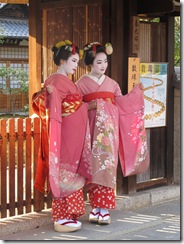
Although my visit to Kyoto was mostly devoted to temples and other historical sites, I did manage to make time for one slightly more fun location: Toei Uzumasa Studio Park.  This one wasn’t in my guidebook; it had been recommended to me by another ALT who had visited Kyoto previously.  The place was a bit expensive and difficult to find, but it made a nice break from routine.  It wasn’t a traditional theme-park with rides and cotton candy; it was an outdoor film set designed to look like a Meiji-era town, complete with houses, pubs, shops, and even a red light district.  Apparently it’s the kind of set they use to film period T.V. shows, though whether or not actual filming went on there I wasn’t sure.  There were, however, actors walking around the place dressed as geishas and samurais, and having duels with the visiting children.


It was all wonderfully kitschy, especially the motorised plastic sea monster that would awkwardly elevate its head from the town pond, spout a little steam, then just as awkwardly re-submerge itself.  But it was also fairly interesting, and I took my time wandering from building to building.  The local theatre was showing some kind of play about ninjas.  I didn’t understand any of the dialogue in it, nor could I discern good guys from bad guys, but there was lots of fighting, and that part was fun!  Another interesting performance was a demonstration of fight choreography used in T.V. dramas.  That was fairly easy to follow, as they simply showed the techniques used to make stage fighting look real.


Perhaps the oddest attraction in the park was a gallery displaying prints of all of the Forty-Six Views of Mt. Fuji.  These woodblock prints portray Mt. Fuji at different angles, distances, and times of year, and the most famous of them, The Great Wave off Kanagawa, is one of Japan’s most recognisable images.  I’d seen several of the pictures before, but this was my first opportunity to view them all together.


There were lots of other attractions at the park, like a little anime museum and the Japanese movie archives.  When I had finally seen all I wanted, I took a bus up to the northern end of the city for the last must-see location on my Kyoto sight-seeing itinerary: Kinkaku-ji, the golden pavilion.  This one actually is covered in gold leaf, and in the mid-afternoon sunlight it’s quite a sight – even to someone who’s been all over Japan and seen all number of temples.  It is, however, one of those sights that’s more to be consumed than experienced.  You wait in a long line, jostle to the front for a good view, snap your pictures, and then wander off to the souvenir store.  At least we were able to wander around the pavilion and see it from different angles, although the first one was still the best.


On my way home, I was surprised in the metro station to come across a troupe of folk musicians playing beautiful music with a traditional northern-European sound.  I was so enraptured that I bought their CD right there on the spot!

 IMG_2090


My last day in Kyoto was rainy again, so I set it aside for indoor activities.  First, I tried to go to the Kyoto National Museum, but it was closed for renovations.  Instead, I crossed the street and visited the Sanjūsangen-dō temple, famed for housing one thousand and one statues of Thousand-Armed Kannon.  I kept dry for forty-five minutes, walking up one side of the hall and down the other.  Then, unable to think of anything else to do, I retired to my bunk for the rest of the afternoon.  In the evening I returned to the Higashiyama for the evening light-up of the temples and view of the city.


And so my time in Kyoto came to an end.  The most famously beautiful of Japanese cities did not charm me the way I hoped it would, though I’m willing to chalk that up to time of year and circumstances rather than deficiencies in the city itself.  I left on Sunday morning, richer in souvenirs and poorer in yen.  But I did not return directly to Sendai, because first I had to make another pilgrimage that I’d been promising myself for the last year.  Before I left Japan, I had to return to the city I’d visited on my way home from Osaka and that had, in less than twenty-four hours, stolen my heart: Kanazawa.

IMG_2018 


Why I love Kanazawa: I get asked this question a lot, and am always at a loss for a good answer, but here are a few factors that spring to mind.


1. Waterways – The interesting part of the city lies between two rivers, and is criss-crossed by canals, meaning that if you enjoy a leisurely stroll along the waterfront there are plenty of routes to oblige you.
2. Old buildings – As I mentioned on my previous visit, Kanazawa sustained much less damage in the Second World War than bigger Japanese cities, so you see a lot more old-fashioned architecture around.
3. It’s tiny! – Kanazawa is a medium-sized city, but the touristy area is only about four kilometres across, meaning that from Kanazawa Station there’s virtually nowhere you might want to go that you can’t walk to in under half an hour.


I’ll admit that explanation sounds a bit lame, even to me.  I’m met with scepticism whenever I deliver my Kanazawa pitch, and often I feel it myself.  As I walked from the train station to my ryōkan (“guest house”, the same converted kimono shop I’d stayed at last time), I asked myself what on earth I was doing there.  But then I walked from the ryōkan through the samurai district, and I suddenly remembered the answer: Kanazawa is lovely!


I stayed in the city for only three nights, enough, I felt, to see the it properly without getting bored of it.  On the afternoon of my arrival, I walked through the local neighbourhood, admiring the traditional houses once occupied by the samurai class, and toured one of the nicer ones with a particularly striking garden.  Then I took myself out for some of the best okonomiyaki I’ve ever had!


Since Kanazawa is such a small city with so many waterways, I thought the perfect way to explore it would be by bicycle; and, as luck would have it, I could rent one for only $4.00 at my guest house.  So the next morning, after some embarrassing difficulty with the lock and a pit-stop for snacks, I set out bravely for my third bike-riding adventure in almost a decade!


It actually went quite well.  Though I may not have been as fast as expert cyclists, the bike certainly got me around quicker than my feet would.  I kept to the sidewalks, hugged the kerbs, and walked the dangerous-looking bits, and in that way I managed to get myself around without mishap or injury.  Well, sort of.  I actually took a tumble walking through the Nishi Chaya district when I put my foot in a gutter that was missing part of its grating.  I pitched forward onto my face, tearing my jeans, skinning my palms, and cutting my knee.  I sat by the side of the road for five minutes sobbing like a child and trying to mop up the blood with a wet wipe before a friendly worker at the local deaf-people’s centre took pity on me and ran out to help.  By the time she’d gotten me cleaned up and bandaged I was ready to continue my adventure.


And you know what?  It didn’t ruin my day the tiniest bit!  Because Kanazawa is lovely and the weather was perfect.  So I saw the Nishi Chaya (“west tea-house”) district and the temples along Tera-Machi-dori.  Then I cycled across town to the Higashi Chaya (“east tea-house”) district.  I enjoyed a relaxing ride along the river, taking pictures of some of the more interesting bridges; walked around the tea-house district and took a tour of one of the tea-houses; and somehow ended up drinking tea and eating sweets at a temple with the caretaker and his wife.  In the evening I went to a recommended restaurant for my first ever Tongan meal, which again proved quite enjoyable.


Rather than let next day’s rain spoil my mood, I devoted it to museums, visiting first the Museum of Contemporary Art, and then the Museum for Traditional Products and Crafts.  The former unsurprisingly failed to grip me, but the latter was full of beautiful goods traditionally made in the area.  I spent my last evening at the ryōkan, hiding from the rain and sharing Japanese take-away dinners with the other patrons.  I’m deeply grateful I got the chance to visit Kanazawa for a second time, and I am now officially putting it at the top of my list of Favourite Japanese Cities.

IMG_2097


My return trip was much better planned than my outbound one, but proved as much an adventure as my post-earthquake journey to Osaka!  When I got to the train station, I found that the strong winds from the previous night had delayed the trains, and there was no telling when I might be able to get to Niigata.  I swallowed my panic, having committed to working the following day, and tried to find an alternative.  It seemed the only bus directly from Kanazawa to Sendai was a night bus, and there were no seats available until the following night.  (Can I just take this opportunity to point out that if you’re only going to run one bus between two cities, it seems unnecessarily sadistic to run it at such a time as to deprive your helpless vacationer of a night’s sleep?!)  Upon making further enquiries, I ascertained that there would be no buses or trains from Kanazawa to any of the stops on my planned route, at least until the trains started running again.  So, rather than submit to a seemingly inevitable fourth night in Kanazawa, I cashed in my ticket and boarded a bus to Toyama in search of better luck.


I’ll spare you the details of my journey.  Suffice it to say that fifteen hours, two buses, three trains, and five cities later, I finally pulled into my own proper station.  I’d never been so happy to see Sendai in my life!  I felt stupefyingly lucky to have made it back within the day, and not a little proud of my own resourcefulness.  I felt even luckier after talking to my Singaporean buddy, who was coming back from Hiroshima on the same day and endured a nightmare journey including an unscheduled stopover in Tokyo.  We both agreed that, as long as we’re calling it “home”, there’s no place like Sendai!


IMG_2042


Books I’ve read this fortnight:


Winnie-the-Pooh and The House at Pooh Corner by A. A. Milne – Okay, so technically I listened to the unabridged audio-books rather than reading them.  But if you’re going to be pedantic about these things you could also say that I didn’t read The Lord of the Rings until I was eighteen, and never read any of the Shannara books – only listened to my father read them.  In any case, it had been too long since I’d read these books, and I was happy for them to keep me company on my trans-island journey.  They are, just as I remembered, delightful books, full of humour, wisdom, and some of the most loveable characters in children’s literature.  I enjoyed every chapter, and found myself getting tearful at the last one.


The Girl who Played with Fire by Stieg Larsson – The much-improved sequel to The Girl with the Dragon Tattoo – and incidentally the only novel of the Millennium Trilogy with the same name in Swedish and English!  Like its predecessor, it takes a while to get interesting, but it has an intriguing story and spends much more time on its title character.  Lisbeth Salander is definitely an engaging protagonist, with a good share of both exceptional abilities and character flaws, and an eccentric yet intelligible personality.

Friday, January 11, 2013

Not Nearly as Interesting as Last March - March 2012


The past seven months have been a continuous déjà vu for me.  Novel experiences from my first year in Japan have, on the reliving, become familiar, better, or less interesting.  Every event in the school calendar is greeted with recognition: Ah!  It’s School Festival time again!  Can I attend any of the sporting events this time?  How am I going to spend this Christmas?  What?  You mean I have to do something for the skills-development conference this year?  So, of course, as we progress through the month of March I keep looking back to the previous one for cues on what to expect.  And about half-way through the month the system breaks down as I try to remember the last two weeks of the school year.

That’s funny, I think.  What happened at graduation last year?  Why can’t I remember the end-of-year party?  And what did I do for the last two weeks of class?  And then it comes back to me: Rice balls.  Sleeping on the floor.  Quiet desperation.  Earthquake.

My brain, seduced by the routine, finds itself anticipating disaster: looking forward to power-outages and emergency rations with the same inevitability as staff shuffles and spring break.  I wonder how my co-workers can avoid this trap, but then this is only my second year in Japan; everyone else is used to routines that don’t involve earthquakes.  The Friday before graduation I half expected an earthquake to happen, but 3:00 came and went and the ground stayed put.  And so I had yet another first-time experience in Japan: the experience of a normal March.

We had a lot of parties this March.  There was one for the “fourth year” teachers that was held at a miso-themed restaurant.  It made me appreciate how much I’ve grown to like miso during my time here, and how much I’m going to miss it.  We had another one the night of the graduation ceremony, and my tea lady organised one for some of her teacher friends.  We had karaoke again after that one.  I tried my vocal chords at “Ue o Muite Arukou” (a famous Japanese song known inexplicably to the English-speaking world as “Sukiyaki”), and freaked everybody out by screaming in the middle of the second verse of “Comfortably Numb” (What???  It was right there in the lyrics!!!)

I also met up a couple of times with the Australian ALT who’d been here last year.  She came back to Sendai to visit friends and participate in the earthquake anniversary observances.  Surprisingly, these weren’t nearly as big a deal in Sendai as I would have expected.  Perhaps it’s partly because I don’t speak the language, but it didn’t seem to me that the people around me were planning on doing nearly as much commemorating as one would have expected.  When I asked my co-workers they talked about staying home or maybe doing some shopping.  It seemed odd to me that people from Japan – i.e. those I’d expected to take the earthquake anniversary most seriously – seemed least interested in observing it.  Perhaps Japanese people just deal with things differently from Americans.

There were commemorative events happening, however, and I was sure to go to them.  On Sunday, March 11, a memorial service was held at the International Center.  It was attended by the mayor, the prime minister (the new one, not the one who’d been in office when the disaster happened), the emperor, and his wife.  It was all in Japanese, of course, which made me feel a bit excluded; still, I was glad to be there, and when we observed the moment of silence, I hoped that I was engaged in a process of collective grieving that transcended language and nationality.

Students in schools around Sendai made banners with messages of encouragement on them.  After the memorial service we went for a walk in the arcade and looked at them.  One of the ALTs who’d left last year also published an essay about the experience.

There was also an event the weekend before the anniversary.  The Tohoku Kibō no Saiten (Celebration of Hope) was a worship event featuring gospel artists from different countries and American evangelist Franklin Graham.  The event ran for three days, but I only made it to one of them.  I enjoyed some of the music.  The line-up included Tsutomu Aragaki, whom I knew of through my second-year textbook.  I quite enjoyed his singing, as well as Alfie Silas, the Tommy Cooms band, and 3rd Wave, a Korean group who sang in English and actually didn’t butcher the language!

I was less impressed with the sermon.  I’d heard Franklin Graham’s father Billy Graham speak in Ottawa back when I was in high school.  I seem to remember that I liked him at the time, though I was much younger and the situation was very different.  At any rate, Franklin Graham’s sermon was not what I was expecting.  It wasn’t subtle, or sensitive, or even particularly interesting.  It was one long alter call, relying heavily on repetition and shouting, and leaving very little room for genuine persuasion or argument.  The earthquake itself, supposedly the reason for the event, only came up once in the sermon – when he warned that anyone who left the stadium unsaved because of timidity or reluctance could have their lives snuffed out as quickly as the tsunami victims did, and lose their chance at salvation.  I was reminded inescapably of the “Death Comes Unexpectedly!!!” sermon in Pollyanna, and expected it to be equally effective.  For a long time it looked like no one was going to respond to the call, but eventually people started coming forward in a trickle, and then a rush.  Which I guess was a good thing, otherwise Mr Graham would have looked pretty silly.  For my part, I went away feeling disappointed and not a little insulted.

I decided to eat normally for Lent this year, instead forgoing entertainment for seven weeks.  I’ve given up some of my favourite web sites, which have of late been making too many demands on my time, as well as all movie and music rentals, purchases, and downloads.  Not books, though!  I thought it would be a big sacrifice, but I’m actually coping pretty well, and pleased that I now have more time for other things.

I didn’t do anything special with my graduating students.  One of the third-year classes, my favourite, gave me a “thank you” card, which was unexpected and sweet.  The five students who had written replies to the Canadian children I gifted with the Canadians’ original letters.  The rest I’ll probably have to leave with my supervisor when I go.  One of the girls actually got a reply from Canada!  I didn’t get a chance to see it, but it’s nice to know that some meaningful communication was able to happen between children on opposite sides of the world.

The graduation was much as I remembered, except that this year it ran as scheduled.  Also, the female teachers of the graduating classes all showed up wearing kimonos!  This is apparently an annual tradition, but it was a shock to me, as they’d forgone the practice at the austerity ceremony.

The end of the school year has brought one more change: staff shuffles.  These were announced on the last day of school before spring break.  There are actually very few teachers leaving my school this year.  We’re losing our principal, but all of the English teachers are staying.  I knew a lot of that already, as teachers are told in advance whether they’ll be changing schools.  But there’s one group of people who aren’t told in advance, who have to wait for the very end of the year to learn where they will be in April: the support staff.  And as it turned out my accountant was staying, my nurse was staying, but my favourite person on the entire staff was leaving us.  That’s right: my tea lady.  My wonderful wonderful tea lady, who’s been my mother and aunt and big sister, my friend and tour-guide and teacher for as long as I’ve been in Japan.  I’m devastated.  I can’t imagine what the school’s going to be like without her.  True, we’ll probably keep in touch; true, I’ll have lot’s of chances to see her again.  But it won’t be the same.

I’m particularly annoyed that she’s being transferred to an elementary school.  At a junior high school she’d at least have an ALT, but at an elementary school the best she can hope for is one to visit once a week.  If she was getting a new ALT at least I could be philosophical about it and comfort myself with the knowledge that someone else could benefit from knowing her.  In my opinion, anyone so friendly, so helpful, and so skilled in the art of gaijin-go* is really wasted on a school with no foreigners.  Unfortunately, there’s nothing at all I can do about it.

In the news this month, Mexico had an earthquake.  This caused me some brief concern, as my sister is currently visiting the country, but she’s fine.  The Canadian government is enacting new “tough on crime” legislation.  The legislation involves things like tougher mandatory minimums for some crimes.  I’ve been listening to some of the debate around it, and it sounds like it has the same problem as a lot of similar legislation: it isn’t so much “tough on crime” as “tough on criminals”.  Which seems like a pretty poor substitute, if you ask me.  Dear Mr Harper, if I am ever the victim of a crime I expect it might give me a modicum of comfort to know that the perpetrator will serve ten years rather than five, but you know what I would find a thousand times more comforting?  Not being the victim of a crime in the first place!!!  With that in mind, how about you take the money you want to spend incarcerating prisoners for longer, and instead spend it on measures to reduce crime?  It may not sound as exciting, but I think we’ll all be happier in the long run!

Books I’ve read this month:

Grave Peril by Jim Butcher – I had the same problems with the third “Dresden Files” book as I did with the second.  I like Michael, the new character we’re introduced to, and I enjoy the mix of urban fantasy, medieval mythology, and film noir themes.  But I wish Butcher would let up on the violence a bit!

The Girl with the Dragon Tattoo by Stieg Larsson – A pedestrian, run-of-the-mill crime thriller, notable mostly for being quite long and taking a good while to get interesting.  I liked the title character and wished the book included more of her, but despite being a putative central character, she actually receives surprisingly little page-time.  The novel’s original Swedish title, Men Who Hate Women, gives a much more accurate picture of what the novel is about.

* “Gaijin-go”: A term I made up meaning “foreigner language” or “the way a foreigner talks”.  Basically, Japanese simplified for non Japanese-speakers.